Showing posts with label Year of Faith. Show all posts

Sunday, November 24, 2013

The Boss of Me


Read in this light, the prophetic text leads to one conclusion: we need knowledge, we need truth, because without these we cannot stand firm, we cannot move forward. Faith without truth does not save, it does not provide a sure footing. It remains a beautiful story, the projection of our deep yearning for happiness, something capable of satisfying us to the extent that we are willing to deceive ourselves. Either that, or it is reduced to a lofty sentiment which brings consolation and cheer, yet remains prey to the vagaries of our spirit and the changing seasons, incapable of sustaining a steady journey through life.

If such were faith, King Ahaz would be right not to stake his life and the security of his kingdom on a feeling. But precisely because of its intrinsic link to truth, faith is instead able to offer a new light, superior to the king’s calculations, for it sees further into the distance and takes into account the hand of God, who remains faithful to his covenant and his promises.
Lumen Fidei 24

Reflection – Happy Feast of Christ the King. So it is the conclusion of the Year of Faith, and so the last installment (for now, anyway) of this encyclical on the blog. It is a fitting paragraph to go with this feast and this mystery of the kingship of Christ.

Christ as God, Christ as Savior, Christ as Shepherd, Teacher, Healer… all of these are magnificent titles, all of them true of course in themselves. But all of them, I would suggest, can get a little ‘up there’ for us, a little pie in the sky-ish, a little vague and remote. They’re not, really, but from our poor human point of view, they can become that.

But Christ as King? This means, in our modern terms, ‘Christ as Boss’. At the pro-abortion rights counter-demonstration to the Ottawa March for Life this year, one of the signs read, ‘God, you’re not the boss of me!’ To celebrate Christ the King means that Jesus is the boss of me (and of the whole universe besides) and that this is a joyous happy reality.

In other words, not only can I build my life securely on the promises of God in Christ and the way of life he lays out for me in the Gospel, but I must do so. Not because Jesus or the Father is up in heaven with a big stick ready to bash my head in if I show signs of rebellion. Christ is King, not Fuhrer.

But He is really King, the eternal King, the One King of all that is. The whole universe is ordered by the Lordship of Christ, and it is a lordship of love, goodness, gentleness, mercy, and joy. If I reject that Lordship, I reject everything that is really real, really good, really leading me to life and joy and peace.

Well, that’s faith. But it is a faith that only works if it is, in fact, true. If there is no Jesus, or if Jesus was just some good guy 2000 years ago, or maybe was one of many ‘healers’ or ‘teachers’ sent by God (whoever that is), or whatever variation on that theme we care to consider, then there is no point building my whole life on Him, on His promises, His act of salvation, His way of life that opens us for me.

Christian faith is not a head trip or a feeling, some vague nice idea that gets us through the cold dark night but has nothing to offer to clear light of day. It is a simple, sober decision that what we read, what we hear, what has been presented to us about Jesus by the living tradition of the Church is TRUE, and so we can shape our whole life to it.

And of course, since the truth presented to us is far beyond what our puny human efforts can attain, faith also walks hand in hand with mercy. He is a merciful King, and when we fail to live as His subjects, as I certainly do multiple times every day, faith bids me seek that mercy, and try again.
So happy feast day to you! May the Kingship of Christ bring you joy today, and may it be your light for the way and your confidence and hope.

Wednesday, November 20, 2013

What Does It Mean To Love the Church?


In this way, the life of the believer becomes an ecclesial existence, a life lived in the Church. When Saint Paul tells the Christians of Rome that all who believe in Christ make up one body, he urges them not to boast of this; rather, each must think of himself "according to the measure of faith that God has assigned" (Rom 12:3). Those who believe come to see themselves in the light of the faith which they profess: Christ is the mirror in which they find their own image fully realized. And just as Christ gathers to himself all those who believe and makes them his body, so the Christian comes to see himself as a member of this body, in an essential relationship with all other believers. The image of a body does not imply that the believer is simply one part of an anonymous whole, a mere cog in great machine; rather, it brings out the vital union of Christ with believers, and of believers among themselves (cf. Rom 12:4-5) Christians are "one" (cf. Gal 3:28), yet in a way which does not make them lose their individuality; in service to others, they come into their own in the highest degree.
Lumen Fidei 22

Reflection – We’re spending the week with the encyclical on faith, in preparation for the end of the Year of Faith on Sunday. Here we have the rather prickly matter of the relationship of the life of faith to membership in the Church. It is a prickly matter because of course ‘membership in the Church’ means relationship to other human beings, and relationships with other human beings are always marked by pain and difficulty to some degree or other.

On the one hand we have this deeply personal journey—faith, encounter with Christ, the interior transformation of our being into love. On the other, we have being a member of an institution, a structure with its rules and expectations, its flawed human leaders and all the lamentable folly that attends any communal human project—petty politics, back biting, corruption, mediocrity.

The two can seem to have so little to do with each other, right? The spiritual life is one thing over there, and life in St. Cecilia’s parish with its church suppers, raffles, committees, and cliques is over there. What has one to do with the other, and isn’t it rather outrageous of the Church to suggest that there is some necessary and intrinsic connection between the two?

‘Why exactly should I love the Church?’ a directee asked me this one time. It was a real question, and the person had a point. The Church had done very little for her, really. My answer was the only answer there is to give, and it’s the answer given in this paragraph of the encyclical. We should love the Church because Christ loves the Church, and Christ’s love is to be our love. We are espoused to him, each one of us, and so what He loves, we love. It’s that simple, but oh, what a journey that sets us on.

From looking on the Church in a sort of infantile way—the mommy or daddy who we look towards to be a perfect and unfailing presence of love and support for us, and then fall into an adolescent rage when ‘mommy Church’ falls short of the mark or ‘daddy Church’ turns out to a bit of a jerk sometimes—we grow into adults who are called to love and serve our brothers and sisters in the Church as Christ loves and serves them, and as Christ loves and serves us, too.

In this adult love for the Church, an adult love which we enter into with utter childlike simplicity of faith and trust in God, we can then factually be crucified by the concrete difficulties in a specific Church situation. The ravages of human sin moving through the body of Christ like a cancer can cause us deep pain and grief and anger (because we are still intensely human in all this), but we don’t close our hearts and we don’t walk away. 

We take the hit, we stand with Christ at the whipping post, in the Praetorium, on Golgotha. That is what it means to love the Church—certainly always to work towards a more just, a more merciful, a more loving communal life within the Church, but always in that to shoulder the Cross of Christ, always to start with ourselves and our own call to love and be compassionate. Never to point fingers and hurl accusations and blame everyone else for what’s wrong in it, from the Pope on down to the children who don’t know how to behave at Mass.

It is only a deep interior life of faith, only knowing the love of Christ for us and his call to us into that love, that we can possibly endure life in the Church and give ourselves to the ongoing mission of the Church to make God’s merciful love visible in the world. But it’s all deeply connected, and we cannot separate out the two. We love the Church because, and as, Christ loves Her, and our life of faith is expressed in laying down our lives for the Church as Christ laid His down for Her. Simple, but oh, what a journey.

Tuesday, November 19, 2013

All So Much More


We come to see the difference, then, which faith makes for us. Those who believe are transformed by the love to which they have opened their hearts in faith. By their openness to this offer of primordial love, their lives are enlarged and expanded. "It is no longer I who live, but Christ who lives in me" (Gal 2:20). "May Christ dwell in your hearts through faith" (Eph 3:17). The self-awareness of the believer now expands because of the presence of another; it now lives in this other and thus, in love, life takes on a whole new breadth. Here we see the Holy Spirit at work. The Christian can see with the eyes of Jesus and share in his mind, his filial disposition, because he or she shares in his love, which is the Spirit. In the love of Jesus, we receive in a certain way his vision. Without being conformed to him in love, without the presence of the Spirit, it is impossible to confess him as Lord (cf. 1 Cor 12:3).
Lumen Fidei 21

Reflection – Yesterday was a perfect storm of life, work, and various responsibilities that took me far away from blogging. Sorry to have missed ‘deadline’ on that.

Well, it’s the last week of the Year of Faith (remember that?), and so I thought I would stick this whole week with the encyclical on faith co-authored by Popes Benedict and Francis. Faith is always a timely topic—it’s not as if this week is the last chance to talk about it or something—but of course the Church has asked us to make it a special focus right now, so let’s do that, OK?

This paragraph puts faith in a very sharp relief indeed. Faith, the assent of our mind to revealed truth, is not simply some psychological exercise where I go from ‘not believing that some guy named Jesus is God and died and rose from the dead and so I can go to heaven’ to ‘believing all that stuff.’

Faith, while it is a matter of the intellect, in fact places our intellect in its right order in disposing it to enter a whole way of life and being that is characterized by love, communion, encounter with God, and compassion for the world. In other words, faith as ‘assent of intellect’ properly understood places our heads in our hearts, places our minds at the service of hope and love, of mercy, of beauty, of communion.
Faith, in other words, opens a door—the door of faith!—but what comes through that door is in fact the Holy Spirit, the transforming presence and power of God. This is so far removed from the shallow caricatures of faith that are often thrown up against believers. Faith as having ‘an imaginary friend’, faith as turning off one’s intellect for a blind assertion of some wholly irrational world view, faith as mystic nonsense, faith as capitulation to some human authority (‘letting the Pope do your thinking for you!’), faith as (simply) being very, very stupid.

All of that is how non-believers often look upon faith, and indeed we who have faith can slide down that road, too. Or faith can become for us a mere going through the motions, doing certain actions and ascribing to certain truths out of force of habit or fear of hell or simple inertia. There are certainly dry times in our lives when habit is our best friend and tides us over some pretty blank and barren moments, but faith is meant to be more than just routine and rote obedience.

It’s all about the relationship, eh? It’s all about God coming to us, and knocking at the door of our hearts, and faith opening that door, so that love can come in. So that love can begin to transform us into love, so that Christ can transform us into Christ, so that the mind, heart, eyes, and will of Christ become (miracle of miracles of miracles) our mind, heart, eyes, and will.

It is all so much more than it seemed when we first started to believe. There may indeed be an initial surrender, an initial sense of shutting the mind off or accepting the authority of the Church blindly… but out of that springs this whole interior world, this whole interior life in which the mind is energized, the inner person is strengthened, the whole of our humanity sharpens to an fine point of focus and energy, when a love and a Spirit that is not ours begins to stir within, when all that Christ is begins to move and shape and expand within us, yeast in the dough, the seed in the earth, and what a strange plant begins to burst out of the hard and barren soil of our humanity, what a strange life begins to live within us. Faith does all this, if we accede to its movements and the truths it teaches us.

It is all so much more than we thought it was, at first.

Sunday, October 13, 2013

Saying Yes to the Impossible

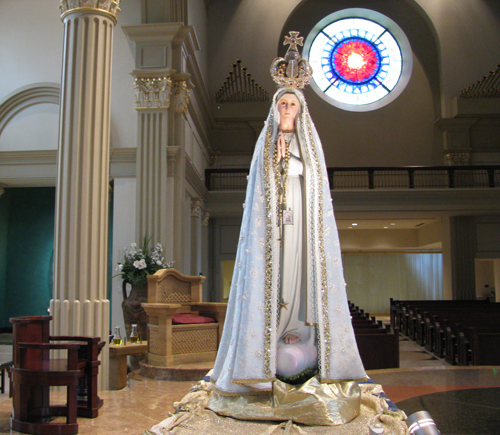
Yesterday and today in Rome, a most beautiful event of the Year of Faith is taking place. The 'Marian Day' of the year is today, on the anniversary of the Miracle of the Sun at Fatima. The statue of Our Lady of Fatima has travelled from her home in the Chapel of the Apparitions in that shrine to Rome, and there have been myriad events over the weekend. It will all culminate today as Pope Francis consecrates the whole world to the Immaculate Heart of Mary, or properly speaking, to Jesus through Mary.

Here in Madonna House, we have our own statue of Our Lady of Fatima, actually one of the three official statues commissioned to be 'pilgrim Virgins'. It was in the care of our associate priest Fr. Patrick Moore SFM, who travelled around the world twenty times with it, bringing the message of Our Lady of Fatima everywhere. He had a great love of MH and willed the statue to us at his death.
Pilgrim Virgin of Fatima (not our MH statue, though)
So today we are going to have our own little pilgrimage with Our Lady from the upstairs chapel where she now lives to our Russian chapel in the woods. At the end of Vespers we will renew our own consecration to Jesus through Her, according to the formula of St. Louis de Montfort.

So what's it all about, anyhow? It's all about faith, right? In this Year of Faith, the Church is holding out Mary as the pattern of the believing Christian, the blessed one who believed that what the Lord had said would be done to her. That's the essence of faith, that what God says is true, and that we can build our life upon it. So I want to simply offer here what I wrote on Mary and faith in my book The Air We Breathe, on Our Lady in the writings and thought of Catherine de Hueck Doherty. May Our Lady help us all to come to a deeper faith through our efforts to entrust ourselves to her more deeply:


“The tragedy of our era is a lack of faith.”[i] The way back to God and love that the world needs to find is the way of faith. When Catherine speaks of the lack of faith in the world, she primarily means those who are in the Church but who are not living what they say they believe. “To profess to believe, and not to believe, is one of the great tragedies of our times. People look at Christians—be they Catholic or Protestant—and say to themselves: ‘Those people do not love each other, not the way God says they should. There is no sign of it.’”[ii]

Faith is not, for Catherine, something that remains in the intellect as an act of assent to some truth. For her, faith must be expressed in action and in obedience. In this she stands in a tradition extending back to St. Paul (cf. Rom 1:5; 16:26). Mary shows us what this obedience looks like, and points to us the way we are to walk to bring faith back into the world. First, there is her acceptance of becoming pregnant:

She realized fully well what [this] meant…Joseph didn’t know what to do…Would you believe that your wife was overshadowed by the Holy Spirit? What faith did it take to do that? People want me to tell my attitude to Our Lady. My attitude to Our Lady is one of awe, love. Because she’s a human being like you and I, of flesh and blood… I say to myself “what faith!” Have I got that kind of faith? There are days when I think I have faith. But, then, I look at her, and I say to myself: “Why don’t I pray for more faith?” Lord, I believe, help my unbelief. [iii]

            Mary exemplifies the faith that expresses itself in trust. In the modern world, we are accustomed to analyzing situations, to figuring everything out. Risk avoidance and hedging of bets are the watchwords of the day. Her fiat to becoming virginally pregnant led Mary directly into a level of trust that beggars our imagination. God placed her, with her consent, in a situation that was humanly impossible, in which disgrace and even death by stoning were almost certain outcomes. She had to trust that God would work things out with Joseph, with the marriage, with everything.

            Then there is the faith Mary shows when Jesus left her for his public ministry. Catherine loved to meditate on the Gospel account of Mary and Jesus’ other relatives coming to him in his ministry (Mt 12:46-49, Mk 3:31-35, Lk 8:19-21):

When she came to see Him, in front of everybody else, He said: “I have no mother…’ Now, we of the rejected generation, we who tremble when anybody rejects us… we who are conformist to the last degree—how would we accept this rejection from our son? With great faith? She did. She simply departed.[iv]

            There is so much about life in Christ that is impossible to understand. To really follow the path of the Gospel will lead us, inevitably, into times of confusion, into situations where we cannot make any sense of what God is doing, what He is asking of us. The faith that Mary displays in this Gospel episode is the faith that is needed at such times. “How many times do we say ‘Fiat’ when things happen to us? We do not quite understand, because our faith is so weak, what it means.”[v]
In the context of modernity and its challenges, Catherine was especially aware that this trusting acceptance of God’s providential designs was going to be crucial in our ability to meet the challenges of the day:
Faith, how deep - how wide is it? I think that our fate depends on our faith… what have we got? To oppose might with faith is to oppose hate with love, and despair with hope. It’s all we have. But that means we have God. All things are possible to God.[vi]

It never occurred to Catherine that the difficulties of faith in the modern world should lead a Christian to withdraw into a safe haven away from the struggles and confusion. Rather, faith gives us the courage to go forth into heroic service and love, and it is Mary who shows us the path to faith. It is Mary who shows us how to do the impossible, how to live in a world that is incomprehensible, and how to meet all situations with a fiat on our lips and trust in God in our hearts:

Why is it that we are unable to say fiat again and again and again? We go into our little cell, and hide ourselves. We think: “God doesn’t ask this of me”. Christ washed the feet of the people. Why don’t we? We’ve got to get deep into this. We’ve got to get deep into what it is to be poor. We’ve got to get deep into what it is to wash feet. We have to get into depths as to what prayer is. And all this we can find in Our Lady, if we turn to her in grave humility, and say to her: “Look, you are one of us. Teach us the heights to which we can rise. We can’t bear Christ, but we can be pregnant with love of every human being, with a never-ceasing pregnancy—men and women alike—giving life to other people. Mother, teach us how to do it. Teach us how to love. Teach us how to hope. Teach us how to say “Yes” to the impossible.”[vii]


[i] Unpublished Transcript, Spiritual Reading, August 23, 1978.
[ii] Ibid.
[iii] Ibid.
[iv] Ibid.
[v] Ibid.
[vi] Ibid.
[vii] Ibid.